A rough or painful spot on the sole of the foot can easily be mistaken for a corn when it may actually be a plantar wart. Although plantar warts and corns can look similar, they have different causes and characteristic features. Understanding the difference helps patients seek appropriate care. At CCube Homoeopathy, under the guidance of Dr. Rashmi Chandwani, careful case assessment can be used to understand persistent skin complaints and individualized homoeopathic management.
What counts as a plantar wart?
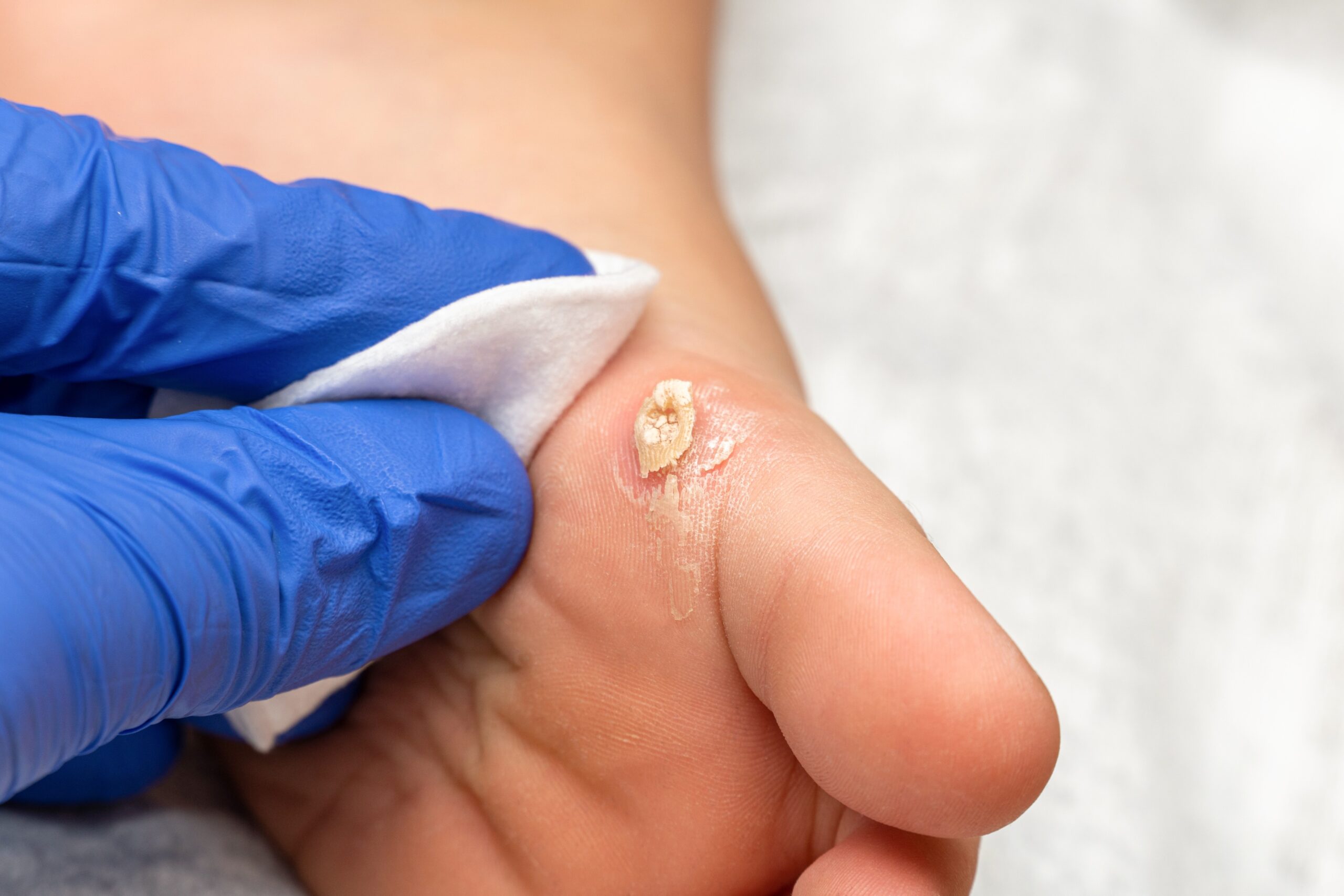
A plantar wart is a type of wart which appears on the soles of the feet. It is linked to the human papillomavirus (HPV) and usually forms in the parts of the sole that bear weight. Since walking puts pressure on the wart, it may at times become flattened and surrounded by thickened skin. At CCube Homoeopathy, Dr. Rashmi Chandwani stress the need to take into account the entire clinical picture rather than focusing solely on the appearance of the skin lesion.
A plantar wart can have a rough or grainy surface and often has tiny black dots in it. These dots are small blood vessels located within the wart and can be seen when the thickened surface is looked at. Plantar warts may occur singly or they may appear as clusters called mosaic warts.
What Is a Corn?
A corn is a thickened and hardened skin area which forms as a result of continual pressure or friction. They are commonly located on the toes, on the sides of the feet and in other areas that are subjected to pressure. Unlike a plantar wart, a corn is not caused by a viral infection. At CCube Homoeopathy Dr. Rashmi Chandwani, takes into account the individual’s full range of symptoms, their sensitivity and their particular circumstances when assessing cases of painful corns.
Corns can have a hard, compact centre surrounded by thickened skin and may become painful when pressure is applied directly onto them. Repeated friction and pressure are major factors in the development of corns.
Plantar Wart vs Corn: The Main Differences
A simple method of telling the difference is to examine the surface, the pattern of pain and the way the skin looks. A plantar wart can disrupt the normal lines of the foot and may have small black spots, while a corn usually appears as a patch of thickened skin without these typical black dots.
The pattern of pain can also serve as a helpful clue: a plantar wart is generally more uncomfortable when the area is squeezed or pinched from the sides, while a corn causes pain when direct downward pressure is applied.
Plantar Wart vs Corn: Difference
- Basic nature: A plantar wart is a skin growth commonly associated with the human papillomavirus (HPV), whereas a corn is an area of thickened skin that develops due to repeated pressure or friction.
- Common location: Plantar warts commonly occur on the sole of the foot, while corns are usually found on the toes, sides of the feet, or other pressure points.
- Surface: A plantar wart generally has a rough, irregular, or grainy surface, whereas a corn usually feels hard, smooth, and thickened.
- Black dots: Plantar warts may show tiny black dots, which can represent small clotted blood vessels, while these dots are usually absent in corns.
- Skin lines: In a plantar wart, the normal skin lines may be interrupted, whereas in a corn, the skin lines generally continue across the thickened area.
- Pain: A plantar wart may be painful when squeezed or pinched from the sides, while a corn often causes pain when direct pressure is applied to it.
- Number: Plantar warts can occur individually or in clusters, whereas corns are usually localized to a specific pressure point.
- Appearance: A plantar wart may appear flattened or cauliflower-like, while a corn typically has a more clearly defined hard central core.
Although this comparison is useful, it is not always possible for appearance alone to lead to a diagnosis. Dr. Rashmi Chandwani advocate for a proper evaluation in the case of a foot lesion that is persistent or changing.
What Makes Plantar Warts Painful?
When standing or walking the sole of the foot is under constant pressure. If a plantar wart appears in a weight-bearing area, the pressure can cause the lesion to be pushed in, which makes it uncomfortable to walk on. In some cases, people compare the sensation to that of walking on a small pebble.
When assessing complaints related to painful plantar lesions at CCube Homoeopathy, Dr. Rashmi Chandwani takes the patient’s individual symptom pattern into account. Homoeopathic case-taking goes beyond the site of the lesion and looks at the patient’s full symptom picture.
Homoeopathic Approach to Plantar Warts
At CCube Homoeopathy Dr. Rashmi Chandwani adopts an individualised approach when dealing with skin problems by taking the patient’s case, examining the features of the lesion together with the related symptoms and looking at the individual’s general constitution before choosing a homoeopathic remedy.
Instead of choosing a medicine just because someone has been described as having a ‘plantar wart’, the homeopathic method seeks to tailor the prescription to the individual. When assessing each case at CCube Homeopathy, factors such as the location, appearance, sensitivity, tendency to come back and any associated symptoms may be taken into account.
Homoeopathic Approach to Corns
Corns are linked with pressure and friction in a local sense, but during a homoeopathic consultation the entire pattern of symptoms specific to the individual may be taken into account. At CCube Homoeopathy Dr. Rashmi Chandwani is able to evaluate the complaint by means of a thorough case-taking and thus arrive at a personalised homoeopathic approach.
The aim of individualized homoeopathic treatment is to consider the patient as a whole rather than concentrating only on a particular thickened patch of skin. While CCube Homoeopathy adopts this patient-oriented method, Dr. Rashmi Chandwani also has a great deal of clinical experience in the evaluation of chronic and recurring symptoms.
Can You Tell the Difference in Your Own Home?
Some clues may be of use; for example, black dots, an uneven surface and pain when the lesion is squeezed from the sides all point to a plantar wart, while a hard area that is mainly painful under direct pressure is more in keeping with a corn.
It doesn’t follow that every rough patch on the sole of the foot is a wart or a corn. When the diagnosis is in doubt, if the lesion changes quickly, bleeds, becomes quite painful or fails to respond as one would expect, it is important to have it assessed by a professional. At CCube Homoeopathy, Dr. Rashmi Chandwani can assist patients in understanding their symptoms by means of a thorough consultation.
At what stage should you get a professional evaluation?
Foot lesions that persist should be given due consideration, especially if the diagnosis is uncertain. One should not automatically suppose that a lesion which changes, bleeds, becomes more painful or appears unusual is merely a corn or a wart.
People who are interested in receiving a personal homeopathic treatment can have a thorough case evaluation carried out at CCube Homoeopathy, by Dr. Rashmi Chandwani; the most important initial step consists in finding out how the lesion looks and feels and also how it has developed over time.
Frequently Asked Questions
How do I know whether I have a plantar wart or a corn?
A rough lesion with possible black dots and interruption of normal skin lines is more suggestive of a plantar wart. A smooth, hard area located at a pressure point is more suggestive of a corn.
Are plantar warts contagious?
Yes. Plantar warts are associated with HPV and can spread through direct or indirect contact.
Are corns contagious?
No. Corns develop from repeated pressure or friction and are not viral infections.
Which homoeopathic medicines are commonly considered for warts?
Thuja, Nitricum acidum, Antimonium crudum, Causticum and Natrum muriaticum are among medicines traditionally considered by homoeopathic practitioners.
Can the same homoeopathic medicine be used for every plantar wart?
No. Homoeopathy emphasizes individualisation. Two people with apparently similar warts may receive different prescriptions based on their overall symptom picture.
How long does homoeopathic treatment take for plantar warts?
The treatment course can vary according to the lesion, duration, number of warts and individual response.
Can a corn be treated with homoeopathy?
Yes. At CCube homoeopathy we individualize the treatment for a person presenting with corns. At the same time, corns are strongly associated with mechanical pressure and friction, identifying and reducing the underlying pressure is important.
CCube Homoeopathy – The Benchmark in Individualized Homoeopathic Care
CCube Homoeopathy, under the care of Dr. Rashmi Chandwani, follows an individualised method of homoeopathic treatment in which the patient’s symptoms, medical history and general presentation are thoroughly taken into account. Instead of treating every plantar wart or corn in the same way, the consultation centres on understanding the patient’s particular symptom pattern. At CCube Homoeopathy, stress is placed on carrying out a detailed case history, prescribing treatment that is tailored to the individual and ensuring appropriate follow-up. The clinical experience of Dr. Rashmi Chandwani enables each case to be evaluated in a wider context, especially in instances where patients have ongoing or long-standing complaints. For those seeking a personalised homoeopathic consultation regarding plantar warts, corns and other chronic skin problems, CCube Homoeopathy seeks to offer a well-structured and patient-oriented experience.
Final Thoughts
At first sight, plantar warts and corns may appear similar, but there are some important differences. Plantar warts are linked to HPV and can have a rough surface, broken skin lines and small black dots, whereas a corn is a local thickening of the skin caused by pressure or friction. The way in which pain is felt can also give a helpful indication, since plantar warts tend to become painful when pressed from the sides and corns usually cause pain under direct pressure. Knowing these differences can help patients to be more conscious of their foot health.
People who would like to receive individualised homoeopathic treatment can turn to CCube Homoeopathy and Dr. Rashmi Chandwani, who provide a tailored approach based on a thorough case history and the individual’s full range of symptoms. By becoming aware, seeking timely consultation and receiving individualised homeopathic care, patients can take a more informed stance when it comes to their foot-related issues.