
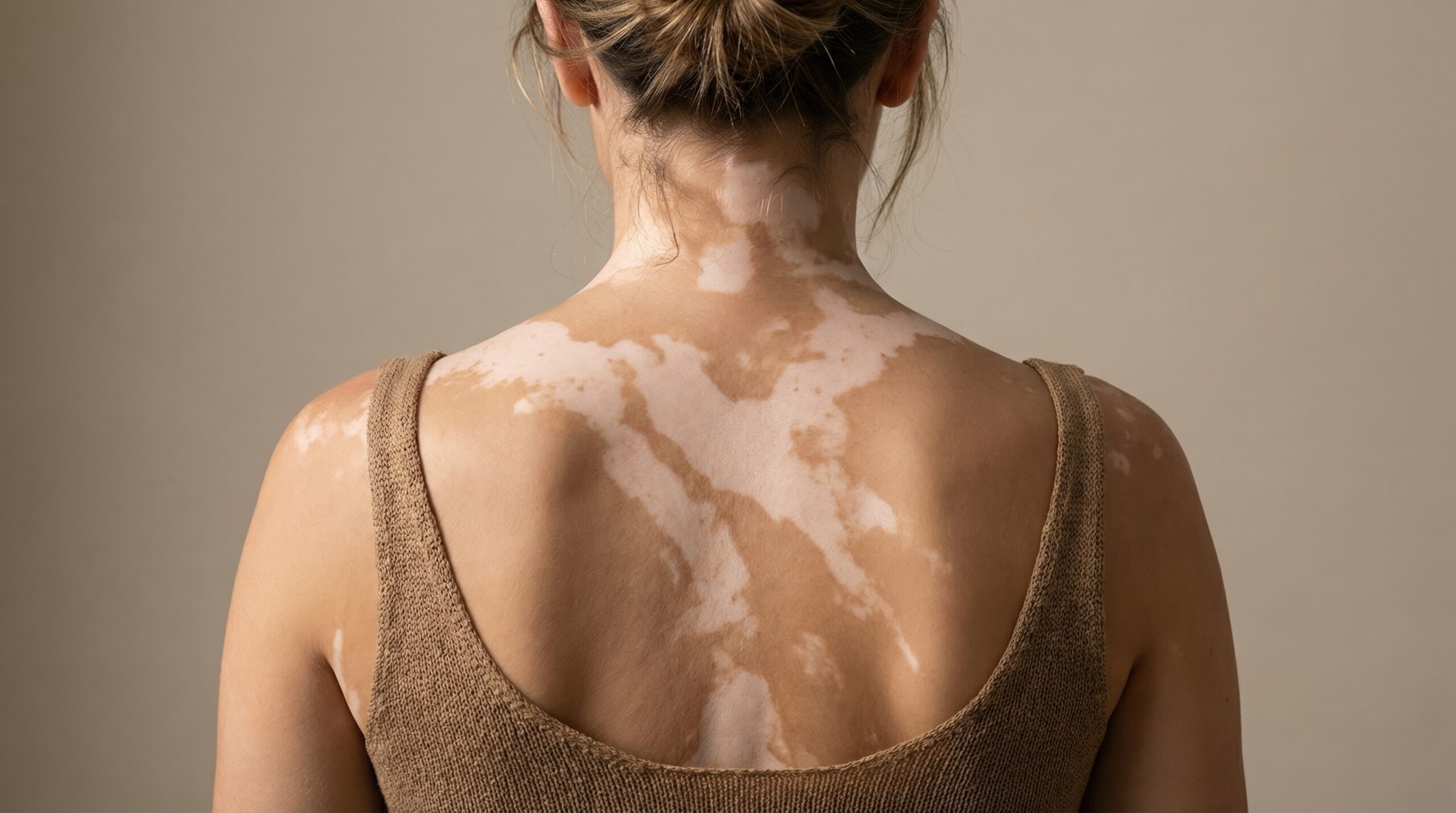
Most people don’t discover vitiligo in a dramatic moment. It’s a pale spot on a knuckle you notice while washing your hands, or a lighter patch near the corner of your lip in the bathroom mirror. You tell yourself it’s a tan line, or maybe a fungal mark, and you move on. A few weeks later, it’s a little bigger.
If that sounds familiar, you’re not alone. At Ccube Homeopathy, Dr Rashmi Chandwani hears this story almost every week. So let’s talk honestly about the early signs of vitiligo and what vitiligo looks like at the beginning, so you know what you’re dealing with and what to do next.
First, What Is Vitiligo?
Vitiligo happens when the cells that give your skin its colour, called melanocytes, stop working in certain areas. The result is lighter or white patches. It isn’t contagious, it isn’t caused by something you ate, and it has nothing to do with hygiene. Still, many people carry a quiet worry about it, and that emotional side deserves as much attention as the skin itself. This is exactly why so many people turn to homeopathy, which looks at the whole person rather than only the patch.
Early Signs of Vitiligo: What Does It Look Like at the Beginning?
The beginning is usually quiet. There’s no pain, no itching, no warning. You’ll typically see small patches that are paler than your normal skin tone, often on the hands, feet, elbows, knees, face, or around the eyes and mouth. Some people notice hair turning white early, in the eyebrows, eyelashes, beard or scalp, even before any skin patch shows up. Others see colour fading inside the mouth or nose.
The patches are usually flat and smooth. They don’t flake, peel or hurt, and that’s a big clue, because many other skin problems do.
How to Tell If Vitiligo Is Starting?
“How do I know if this is vitiligo?” is the question people ask most often. A few things can help you tell.
Look at the colour first. Vitiligo patches tend to be pale beige to milky white, not just slightly faded. Then look at the edges, which are often fairly well defined. Notice whether it itches or scales: fungal infections usually do, while early vitiligo usually doesn’t. And watch for symmetry, since patches often appear on both hands or both knees.
My simplest tip is to take a photo of the patch every two weeks, with the date. It takes ten seconds and tells you far more than memory will. That said, only a trained practitioner can confirm what’s going on. At Ccube Homeopathy, Dr Rashmi Chandwani doesn’t just glance at the patch. She asks about your stress, your sleep, your digestion and your family history, because in homeopathy those details matter.
What Does Stage 1 of Vitiligo Look Like?
People often ask, “What does stage 1 of vitiligo look like?” Vitiligo isn’t always formally staged, but the early phase has a recognisable feel. You’ll usually see one or a few small patches, often smaller than a coin, with partial colour loss. They look more like a soft pale shade than stark white. There’s no discomfort and nothing else going on, which is exactly why it’s so easy to ignore.
But this early phase is a valuable window. Many people feel that the sooner they begin supportive care, the better the chance of helping the body find its balance. Dr Rashmi Chandwani often tells patients at Ccube Homeopathy that “wait and watch” should not mean “wait and forget.”
At What Age Does Vitiligo Start?
Another common question is, “At what age does vitiligo start?” The honest answer is that it can begin at any age. Most people notice their first patch between the ages of 10 and 30, so teenagers and young adults are often the ones standing in front of the mirror, worried. But it can also appear in young children, and it can show up later in adult life. If you or your child has an unexplained pale patch, don’t wait for a “right age” to get it checked.
Why Homeopathy Feels Right for So Many People
Homeopathy begins with a simple idea: two people with the same condition are not the same person. Your vitiligo may be linked to stress, someone else’s to a different pattern entirely. A homeopath studies your emotional health, immunity, digestion, sleep and history, then chooses a remedy for you, not just for the patch.
Patients tend to appreciate that homeopathic remedies are gentle, given in very small doses, and free from harsh creams or procedures. It’s a natural, patient and person-centred approach, and it fits well alongside a healthy lifestyle. Results vary, and consistency matters, but many people value the sense of being treated as a whole human being.
Meet Dr Rashmi Chandwani
Behind Ccube Homeopathy is Dr Rashmi Chandwani, a homeopathic practitioner known for her warm, unhurried style. People often say they walk out of her clinic feeling heard for the first time. She doesn’t stop at the skin. She asks about your worries, your routine and what’s been weighing on you lately, because that’s how the right remedy is found.
For someone with vitiligo, that matters enormously. A new patch can shake your confidence long before it changes your appearance. Dr Rashmi Chandwani understands this, and she pairs her care with realistic, honest guidance. She won’t make wild promises. She will walk with you, step by step, with patience and commitment.
What to Expect at Ccube Homeopathy
A visit to Ccube Homeopathy feels like a conversation, not a rushed appointment. You share your story, Dr Rashmi Chandwani listens, and together you make sense of what your body may be telling you. From there, she prepares a personalised plan, along with simple lifestyle suggestions on food, sleep and stress. Follow-ups are about adjusting care as you change.
If you’ve been looking for a calm, trustworthy place to begin, Ccube Homeopathy is a good one.
What You Can Do Today
Photograph any new patch and note the date. Protect your skin from harsh sun and avoid injuring the affected areas. Try not to experiment with random creams from the internet. Eat fresh, balanced food, and give yourself some breathing room when you’re stressed. Most of all, don’t sit on it. Early attention gives you the most options.
Final Thoughts
Spotting the early signs of vitiligo isn’t the end of the world. It’s your body asking you to pay attention. Now you know how to tell if vitiligo is starting, what stage 1 of vitiligo looks like, and when it commonly begins.
If you’ve noticed a pale patch and it’s been on your mind, take that first step. Reach out to Dr Rashmi Chandwani at Ccube Homeopathy, and start your journey with patience, and care.