Eczema and ringworm can sometimes look surprisingly similar, especially when the skin becomes red, itchy, dry or scaly. However, they are different skin conditions, and distinguishing between them is important before choosing an individualised approach. For people seeking homoeopathic care for eczema or recurrent skin complaints in Delhi, at CCube homoeopathy, Dr. Rashmi Chandwani emphasise detailed case-taking and proper assessment before developing a personalised homoeopathic treatment plan.
What Is Eczema?
Eczema is a term used for various inflammatory skin diseases which may result in itching, dryness, scaling, irritation, cracking and in some cases weeping. Since there are different types of eczema, they can look different; for instance, nummular eczema can cause patches that are round or coin-shaped, and this is one of the reasons why it might be mistaken for ringworm. Dr. Rashmi Chandwani at CCube homoeopathy looks not just at a single patch but at the entire pattern of a person’s skin problem. When receiving a homeopathic consultation, the doctor will go over various details including where the problem is, the presence of itching, dryness, factors which aggravate it, any other symptoms and the patient’s personal medical history in order to tailor the homeopathic method to that individual.
What Is Ringworm?
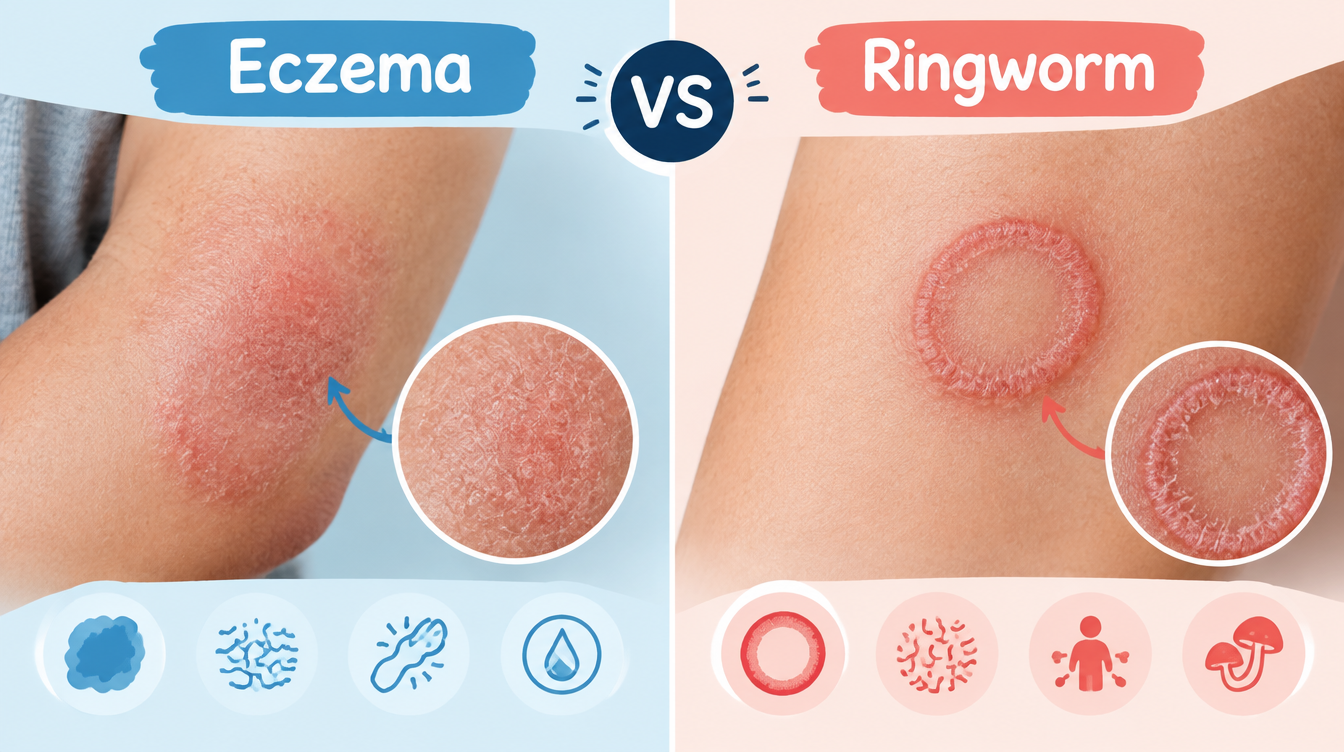
Even though it is called ringworm, it is not caused by a worm; it is a fungal infection which can affect the skin, the scalp or the nails. On the body it usually causes an itchy, circular or ring-shaped rash that has a raised, scaly edge and clearer skin in the middle.
Since ringworm may look similar to other skin conditions, both CCube homoeopathy and Dr. Rashmi Chandwani stress the need for a proper evaluation whenever a new or unusual rash appears. The fact that a rash is present should not immediately lead one to conclude that it is eczema or ringworm.
Eczema vs Ringworm: The Main Differences
A prominent difference lies in the pattern of the rash; ringworm typically appears as a circular or ring-shaped lesion with a more clearly defined, scaly border, whereas eczema may have less clearly defined margins and can look dry, cracked, thickened, inflamed or irregular. Yet there can be a great deal of overlap between the two.
Eczema vs Ringworm
Appearance
- Eczema: May appear dry, inflamed, cracked, scaly, or thickened.
- Ringworm: Often appears circular or ring-shaped with a scaly border.
Border
- Eczema: The border may be less clearly defined.
- Ringworm: Usually has a more clearly defined border.
Itching
- Eczema: Itching is common.
- Ringworm: Itching is common and can sometimes be intense.
Shape
- Eczema: Can be irregular or round, depending on the type.
- Ringworm: Frequently has a ring-shaped appearance.
Spread
- Eczema: Spread varies depending on the type of eczema.
- Ringworm: Can gradually enlarge and may produce additional lesions.
Cause
- Eczema: An inflammatory skin condition.
- Ringworm: A fungal infection.
Assessment
- Eczema: Clinical assessment helps identify the pattern.
- Ringworm: Examination and, when appropriate, fungal testing can help confirm the diagnosis.
At CCube homoeopathy, Dr. Rashmi Chandwani says that instead of trying to diagnose the condition just by looking at photographs or the shape of the rash, people who are experiencing these symptoms should have it properly assessed.
Why Does Eczema Sometimes Look Like Ringworm?
Misunderstanding is especially frequent in the case of nummular eczema, as it may cause round or coin-shaped patches. Since ringworm can lead to circular lesions, the two conditions may look similar at first sight. When assessing a patient with a recurring or unexplained skin problem at CCube homoeopathy, Dr. Rashmi Chandwani considers these variations. Useful information about the onset of the rash, how it changes over time and the symptoms that go with it can be obtained from a thorough history.
Signs That May Suggest Ringworm
A rash deserves proper assessment when it is:
- Circular or ring-shaped
- Gradually increasing in size
- More scaly around the outer edge
- Clearing toward the centre
- Associated with significant itching
- Appearing in multiple locations
- Associated with similar changes on the feet, scalp or nails
Ringworm may as well affect the scalp, the feet, the groin and the nails, and the way it looks depends on the part of the body involved. At CCube homoeopathy, Dr. Rashmi Chandwani says that a proper assessment should be carried out if these symptoms are occurring before an individualised homoeopathic treatment plan is considered.
Signs That May Suggest Eczema
Eczema may be associated with:
- Persistent itching
- Dry or rough skin
- Redness or changes in skin colour
- Scaling
- Cracking
- Thickened skin following repeated scratching
- Oozing in some cases
- Recurrent patches
- Round patches in certain forms such as nummular eczema
Since eczema may show in a number of different ways, CCube homoeopathy looks at the individual case rather than supposing that every itchy patch indicates the same illness. Dr. Rashmi Chandwani regards the patient’s full range of symptoms as part of the personalised approach to taking the case.
Why Proper Assessment Matters ?
A rash that is circular and itchy shouldn’t be immediately called ringworm or eczema since ringworm can look similar to eczema and other skin conditions and in some cases healthcare providers will carry out a skin scraping or some other test to confirm a fungal infection. It is therefore essential to carry out a proper assessment. With CCube homoeopathy, patients are able to talk to Dr. Rashmi Chandwani, who will look at the history and characteristics of their skin problem before proceeding with a personalised homoeopathic approach.
Frequently Asked Questions
What is the difference between eczema and ringworm?
Eczema is an inflammatory skin condition that may cause dryness, redness, itching, scaling, and irritation. Ringworm is a fungal skin infection that often appears as a circular or ring-shaped patch with a more defined, scaly border. Homoeopathy focuses on understanding the individual pattern of symptoms and providing personalized care.
How can I tell if a skin rash is eczema or ringworm?
Eczema can have irregular or differently shaped patches, while ringworm commonly develops as an expanding circular lesion with a clearer border. Itching can occur with both conditions. At CCube Homoeopathy, Dr. Rashmi Chandwani considers the overall symptom pattern when planning individualized homoeopathic care.
Is ringworm always ring-shaped?
No. Ringworm does not always have a perfect ring shape. Its appearance can vary depending on the location and stage of the infection. Homoeopathy approaches skin concerns by considering the person’s complete symptom picture rather than focusing on appearance alone.
Can eczema and ringworm both cause itching?
Yes. Itching is a common symptom associated with both eczema and ringworm. However, the nature, intensity, location, and accompanying skin changes may differ. At CCube Homoeopathy, Dr. Rashmi Chandwani provides individualized homoeopathic medicines based on these symptom characteristics.
Does eczema spread like ringworm?
Eczema may appear in different areas depending on its type and individual triggers, whereas ringworm can gradually enlarge and develop additional patches. CCube Homoeopathy focuses on personalized care by considering the complete presentation of the individual.
Can homoeopathy help with eczema and ringworm?
CCube Homoeopathy offers individualized homoeopathic care for people experiencing concerns such as eczema and ringworm. Dr. Rashmi Chandwani takes into consideration the person’s symptoms, their pattern, and individual health history while developing a personalized homoeopathic approach.
Homoeopathic Consultation for Skin Complaints at CCube homoeopathy
At CCube homoeopathy the homoeopathic consultation focuses on taking a detailed individual case. Dr. Rashmi Chandwani looks at the features of the skin complaint together with any relevant general and personal symptoms.
Details that may be relevant include the time when the problem began, whether it occurs repeatedly, what makes it better or worse, the character of the itching, any changes to the skin, alterations in sleep patterns, general health and other related symptoms. Providing this kind of detailed information enables CCube homoeopathy to formulate a personalised homoeopathic approach rather than depending only on the name of the skin condition.
CCube homoeopathy – The Pioneer in Individualised Homoeopathic Care
CCube homoeopathy has based its method on providing personalised homoeopathic care, taking a detailed medical history and viewing each patient as an individual. When it comes to skin problems such as frequent itching, dryness, rashes and other chronic conditions, CCube homoeopathy stresses the importance of understanding the full range of symptoms as well as the individual characteristics of the patient. The approach of CCube homoeopathy places emphasis on accurate assessment, thorough history-taking, the preparation of personalised homoeopathic prescriptions and ongoing follow-up. For people in Delhi seeking homoeopathic treatment for eczema or other recurrent skin problems, Dr. Rashmi Chandwani and CCube homoeopathy offer a structured consultation process which is focused on individualised homoeopathic care. The dedication to understanding the patient rather than merely concentrating on one obvious symptom is at the heart of CCube homoeopathy’s philosophy and its method of delivering personalised homoeopathy.
Final Thoughts
Although both eczema and ringworm can cause itching, flaking and visible alterations to the skin, they are separate conditions and can at times be hard to tell apart simply by looking at the appearance. The presence of a circular rash does not mean that someone has ringworm, any more than a dry or itchy patch automatically indicates eczema. It is therefore important to carry out a proper assessment when dealing with any skin complaint that is persistent, recurring or unexplained.
For those in Delhi who are looking for a personalised homeopathic approach, CCube homoeopathy and Dr. Rashmi Chandwani stress detailed case-taking and individualised homeopathic treatment. During the consultation the person’s full range of symptoms, relevant history and individual characteristics are taken into account before a suitable homeopathic plan is formulated.
People who notice a new or changing rash should get a proper assessment carried out so that the true nature of the skin problem can be correctly identified. Because of its focus on personalised consultations, thorough case analysis and follow-up care, CCube homoeopathy offers a structured environment for individuals seeking homeopathic treatment for recurring skin problems.